Beyond the "Send" Button: Why Postman Tests are the Secret to Sleeping Better at Night
Hitting "Send" and eyeballing a 200 isn't testing. How Postman's Tests tab — environment variables, status assertions, and data integrity checks — turns a collection into living documentation your team can trust.
 Vanshit Patel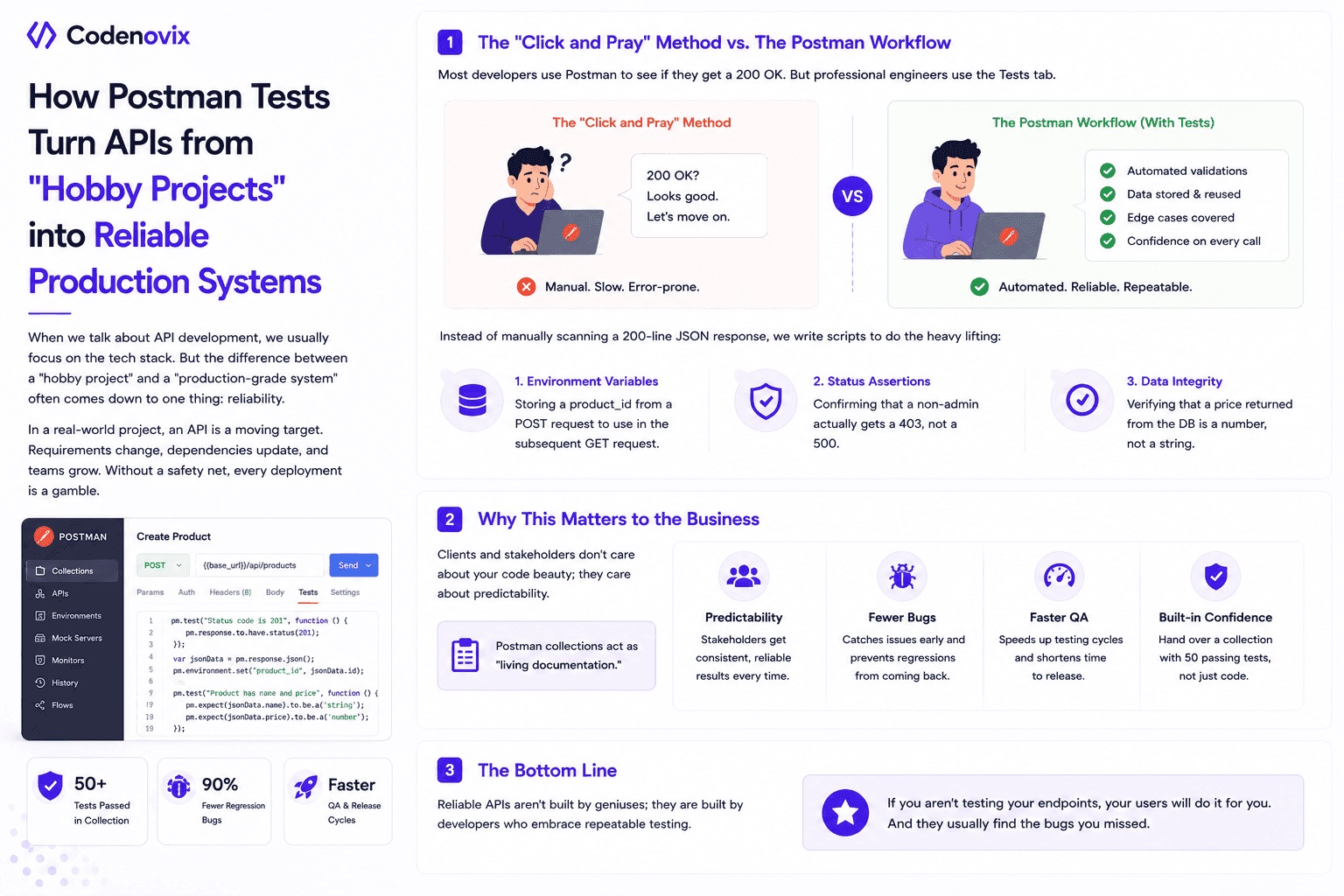
When we talk about API development, we usually focus on the tech stack: Node.js, Python, PostgreSQL, or Go. But the difference between a "hobby project" and a "production-grade system" often comes down to one thing: reliability.
In a real-world project, an API is a moving target. Requirements change, dependencies update, and teams grow. Without a safety net, every deployment is a gamble.
The "Click and Pray" Method vs. The Postman Workflow
Most developers use Postman to see if they get a 200 OK. But professional engineers use the Tests tab.
Instead of manually scanning a 200-line JSON response, we write scripts to do the heavy lifting:
- Environment Variables: Storing a
product_idfrom a POST request to use in the subsequent GET request. - Status Assertions: Confirming that a non-admin actually gets a 403, not a 500.
- Data Integrity: Verifying that a price returned from the DB is a
number, not astring.
Why This Matters to the Business
Clients and stakeholders don't care about your code beauty; they care about predictability. Postman collections act as "living documentation." When you hand over a collection with 50 passing tests, you aren't just handing over code — you're handing over confidence.
It speeds up QA cycles, reduces regression bugs, and ensures that the "backbone" of the app doesn't snap under pressure.
The Bottom Line
Reliable APIs aren't built by geniuses; they are built by developers who embrace repeatable testing. If you aren't testing your endpoints, your users will do it for you. And they usually find the bugs you missed.
Found this useful?
Share it with the dev community or cross-post with a canonical link back here.
Cross-posting to dev.to or Hashnode? Use this as your canonical URL: https://www.codenovix.com/blog/why-postman-tests-matter-for-api-reliability
Related articles
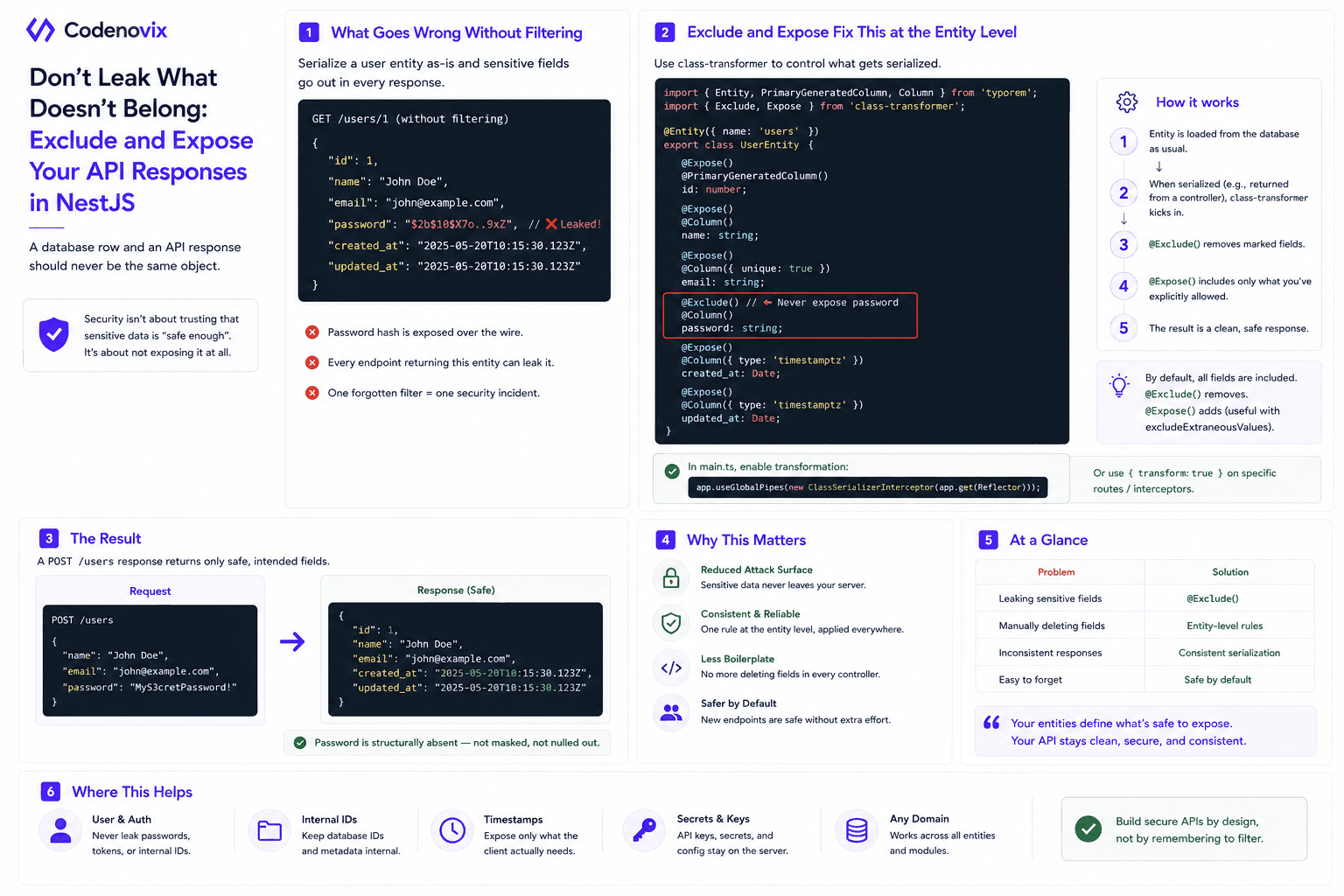
Using Exclude and Expose in NestJS Entities to Control API Responses
A hashed password still shouldn't leave your API. class-transformer's @Exclude and @Expose decorators make an entity define what's safe to serialize, instead of trusting every controller to filter it manually.
 Vanshit Patel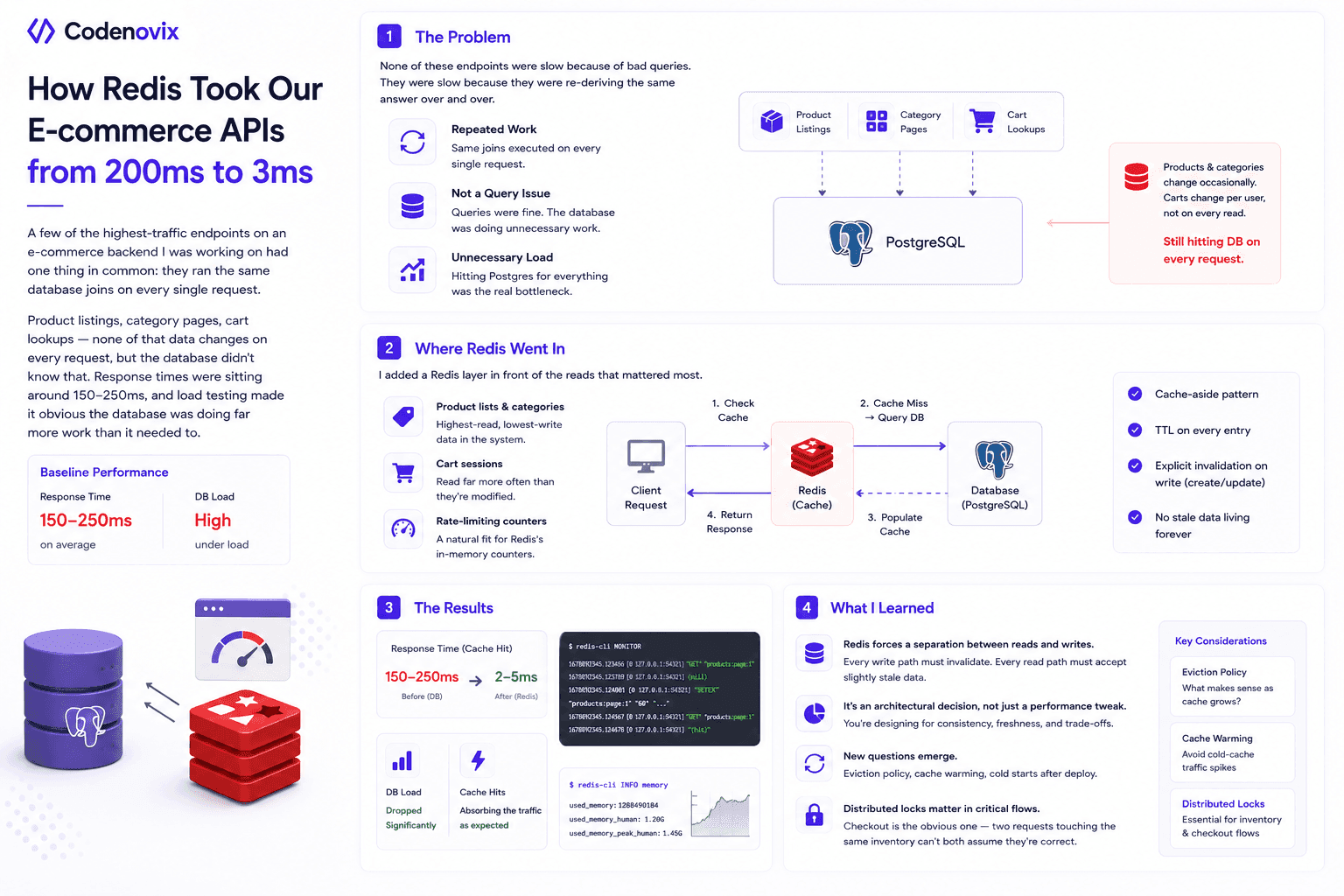
I Added Redis Caching to My E-Commerce Backend, and the Performance Difference Surprised Me
High-read endpoints were re-running the same database joins on every request, pushing response times to 150-250ms. Here's how a cache-aside Redis layer cut that to single-digit milliseconds.
Vanshit Patel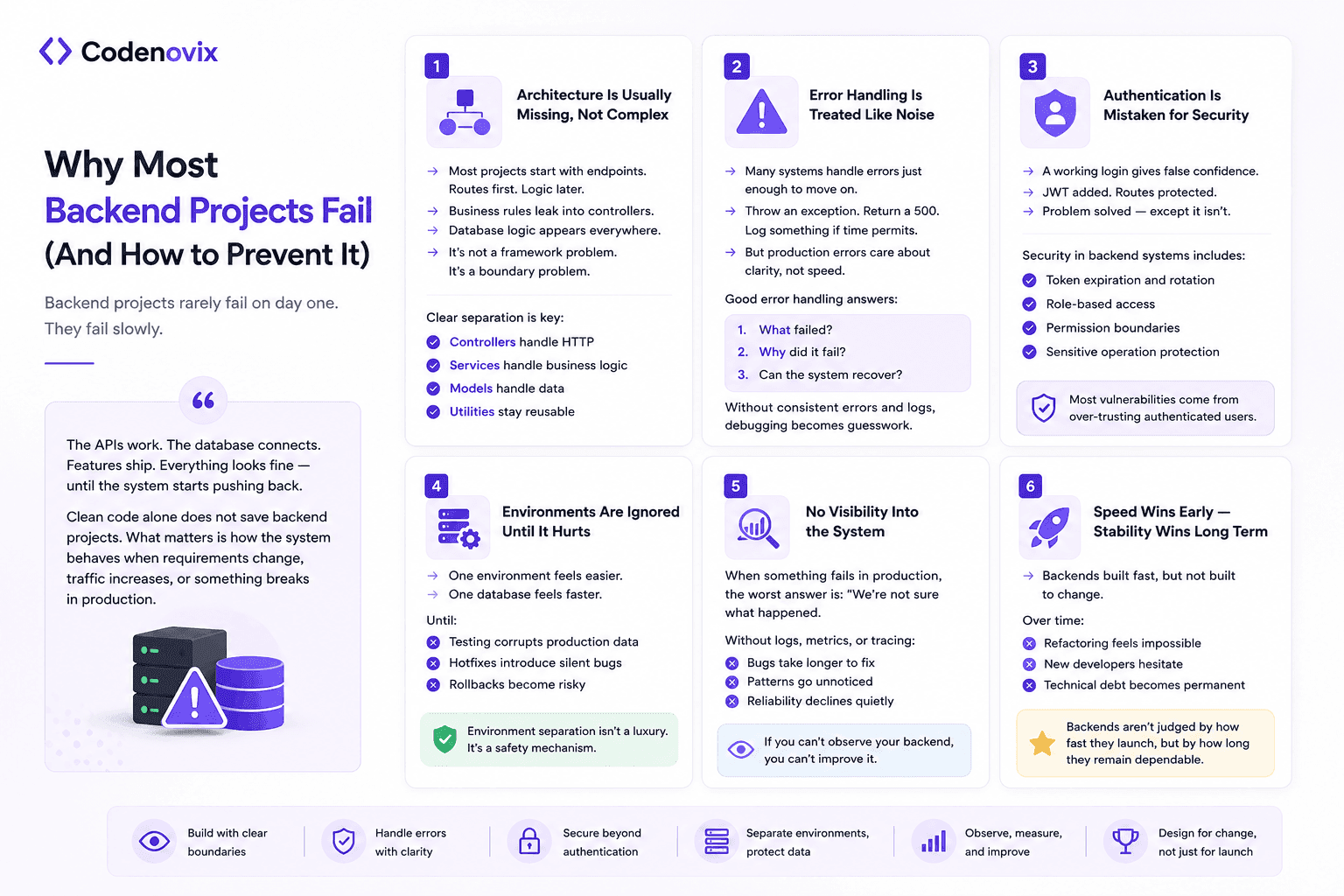
How Designing a Clean Backend Folder Structure Improved Performance and Scalability
A messy backend structure doesn't just look bad — it slows down debugging, onboarding, and scaling. Here's how reorganizing folders into Core, Config, Module, and Shared layers changed both.
Vanshit Patel