How Designing a Clean Backend Folder Structure Improved Performance and Scalability
A messy backend structure doesn't just look bad — it slows down debugging, onboarding, and scaling. Here's how reorganizing folders into Core, Config, Module, and Shared layers changed both.
 Vanshit Patel
When APIs grow and database joins get more complex, the instinct is usually to reach for a technical fix — more caching, better queries, another index. On a recent backend at Sasta Store, the bigger win came from somewhere less obvious: the folder structure. Folders decide how fast a team can move, how easy debugging becomes, and how well APIs scale as the codebase grows.
The Structure
Reorganizing the backend around a small set of clear directories made the biggest difference:
- Core — interceptors, decorators, guards, Stripe integration, and shared utilities
- Config — environment configuration, kept out of business logic entirely
- Health — system health checks, isolated from everything else
- Migration — database schema changes, tracked and reviewable on their own
- Module — business domains and their APIs, one module per domain
- Shared — base entities, constants, and pipes reused across modules
- Seeders — database seed scripts, kept separate from migrations
Why It Mattered
- Centralized logging and error handling instead of duplicating it per module
- Isolated the authentication pipeline so it could change without touching business logic
- Kept business logic modular, so one domain's changes didn't ripple into another
- Made migrations safer to write and review, since schema changes lived in one place
- Simplified onboarding — new developers could guess where something belonged before being told
The Takeaway
None of this was a performance optimization in the traditional sense — no query got faster on its own. But architecture is what makes performance work sustainable: when the structure is clear, it's easier to see where a slow query or a tangled dependency actually lives, and easier to fix it without breaking something else. As APIs grow, the folder structure ends up mattering as much as the code inside it.
Found this useful?
Share it with the dev community or cross-post with a canonical link back here.
Cross-posting to dev.to or Hashnode? Use this as your canonical URL: https://www.codenovix.com/blog/clean-backend-folder-structure-performance-scalability
Related articles
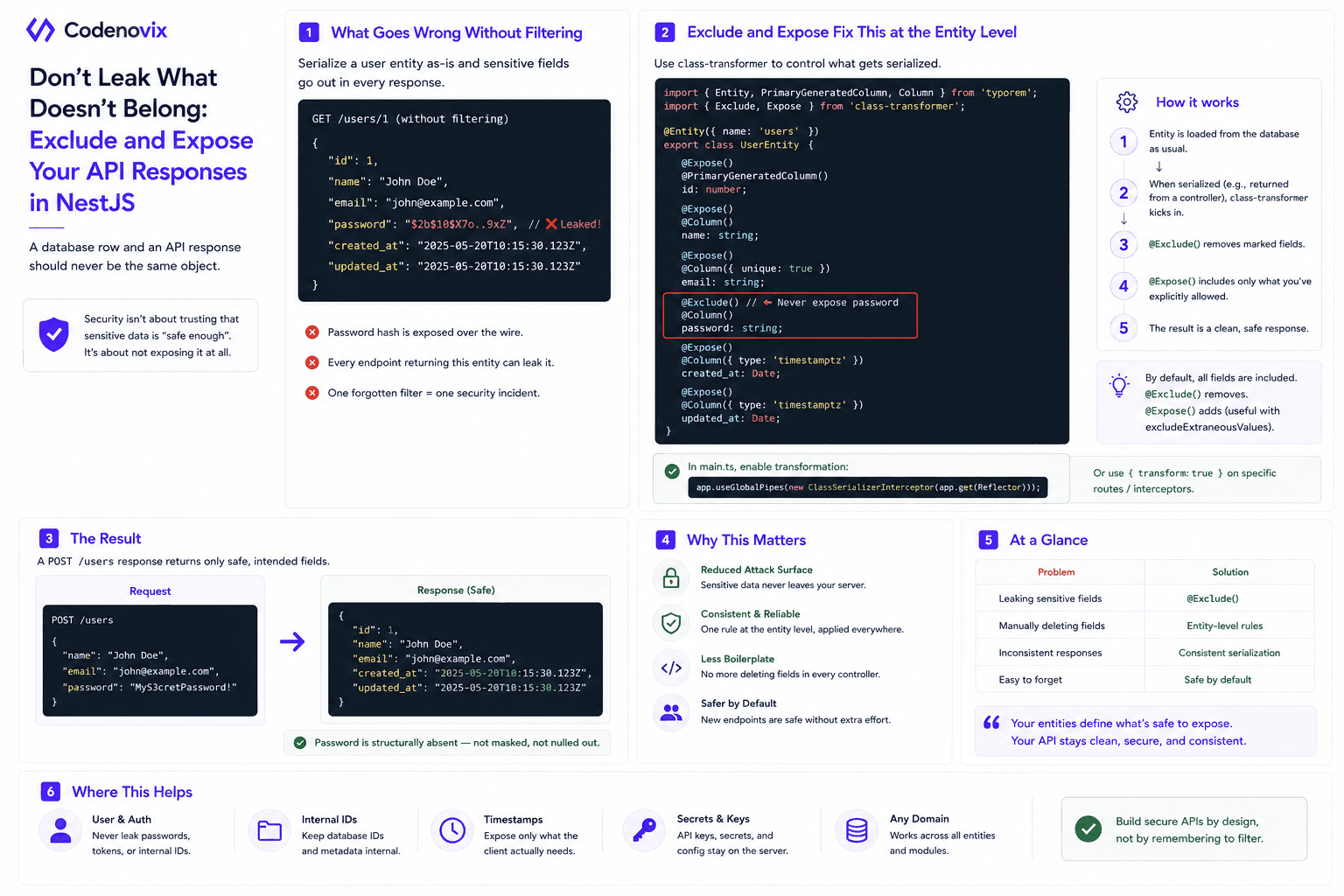
Using Exclude and Expose in NestJS Entities to Control API Responses
A hashed password still shouldn't leave your API. class-transformer's @Exclude and @Expose decorators make an entity define what's safe to serialize, instead of trusting every controller to filter it manually.
 Vanshit Patel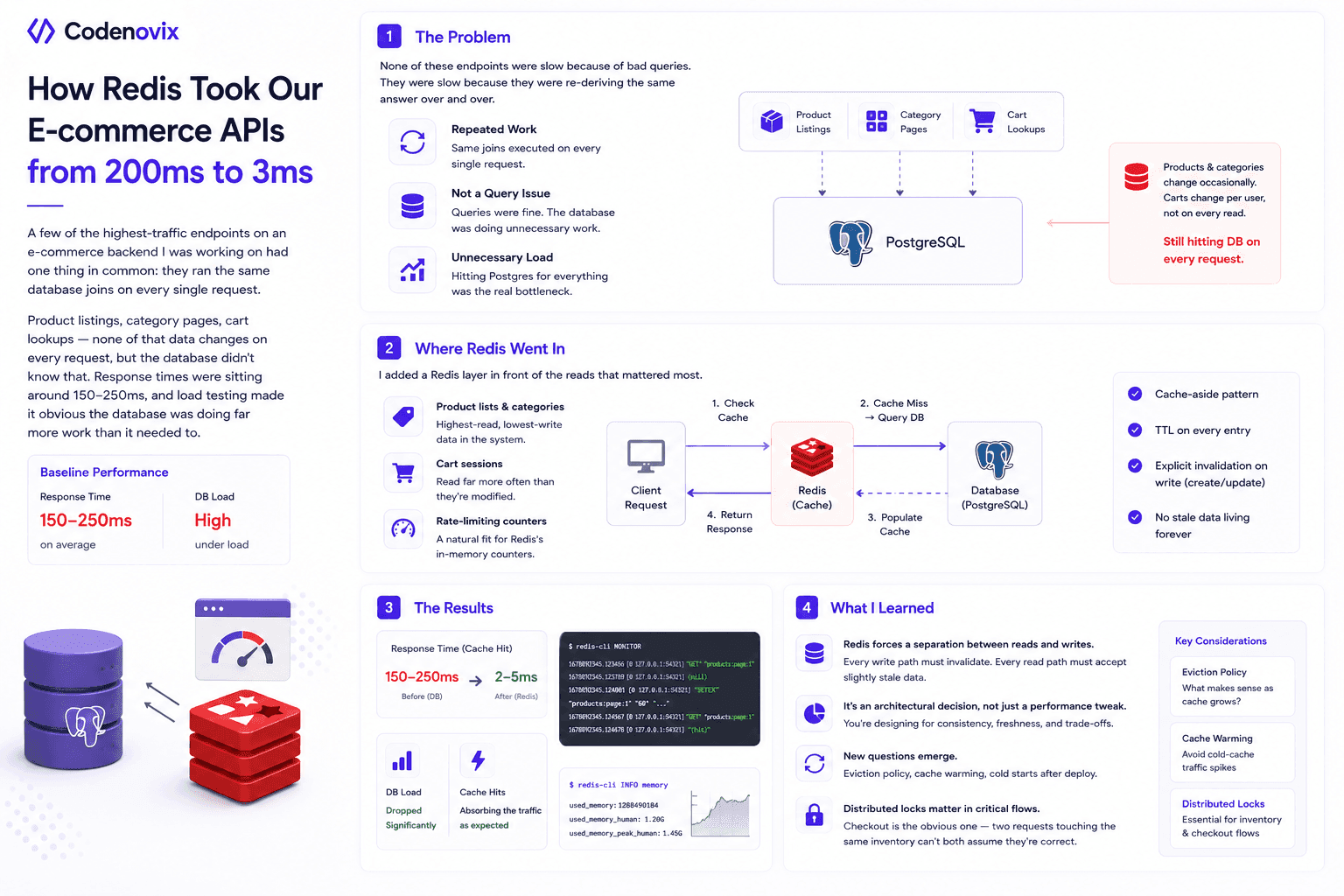
I Added Redis Caching to My E-Commerce Backend, and the Performance Difference Surprised Me
High-read endpoints were re-running the same database joins on every request, pushing response times to 150-250ms. Here's how a cache-aside Redis layer cut that to single-digit milliseconds.
Vanshit Patel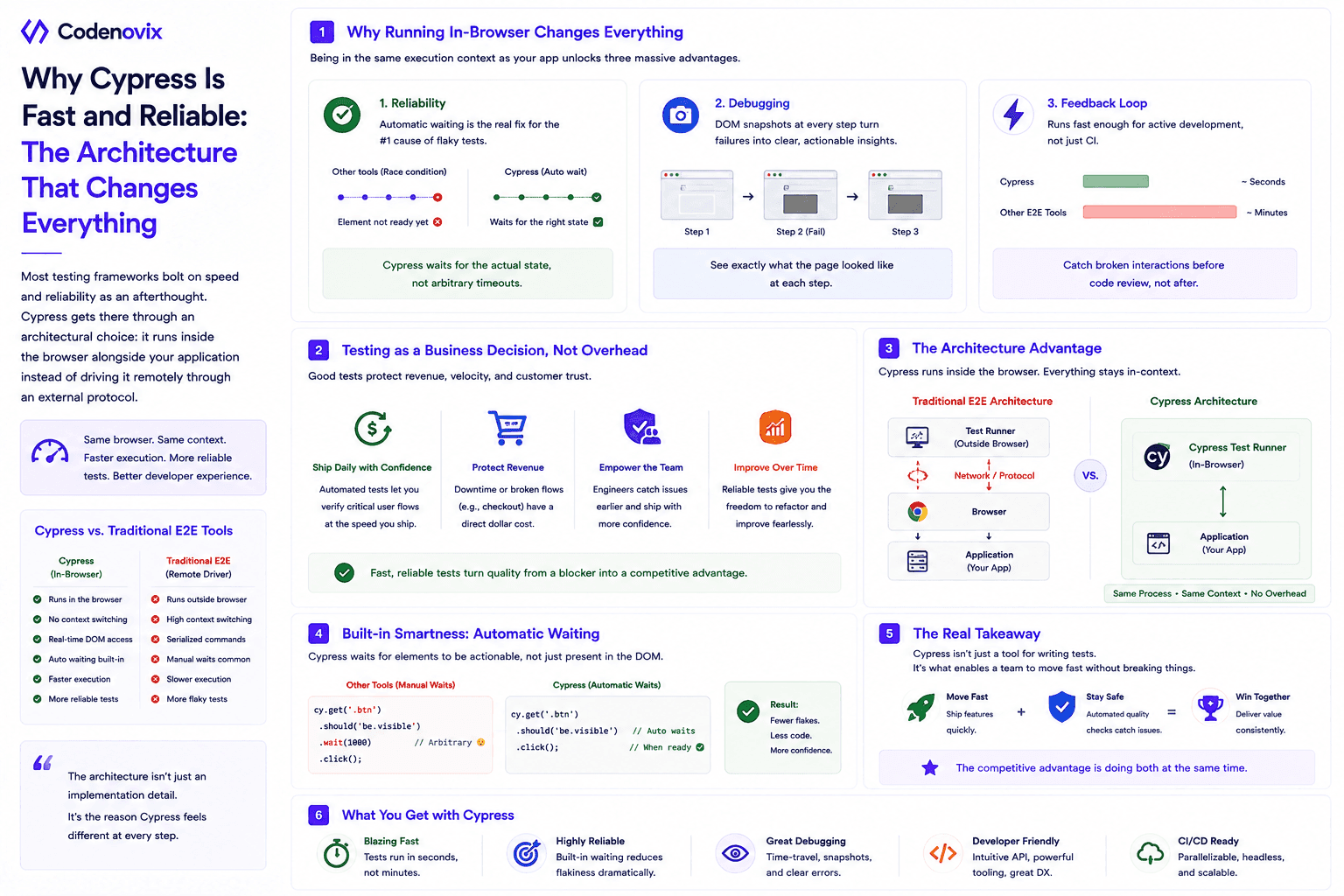
Cypress Testing: Balancing Velocity and Stability in Modern Engineering
Cypress runs inside the browser instead of driving it remotely, which is why its automatic waiting kills flaky tests instead of just hiding them. Speed and stability aren't a tradeoff — they're the same investment.
Vanshit Patel