Why Most Backend Projects Fail (Even When the Code Is Good)
Backend projects rarely fail on day one — they fail slowly. The real culprits: missing architecture boundaries, weak error handling, over-trusted auth, and zero observability.
 Vanshit Patel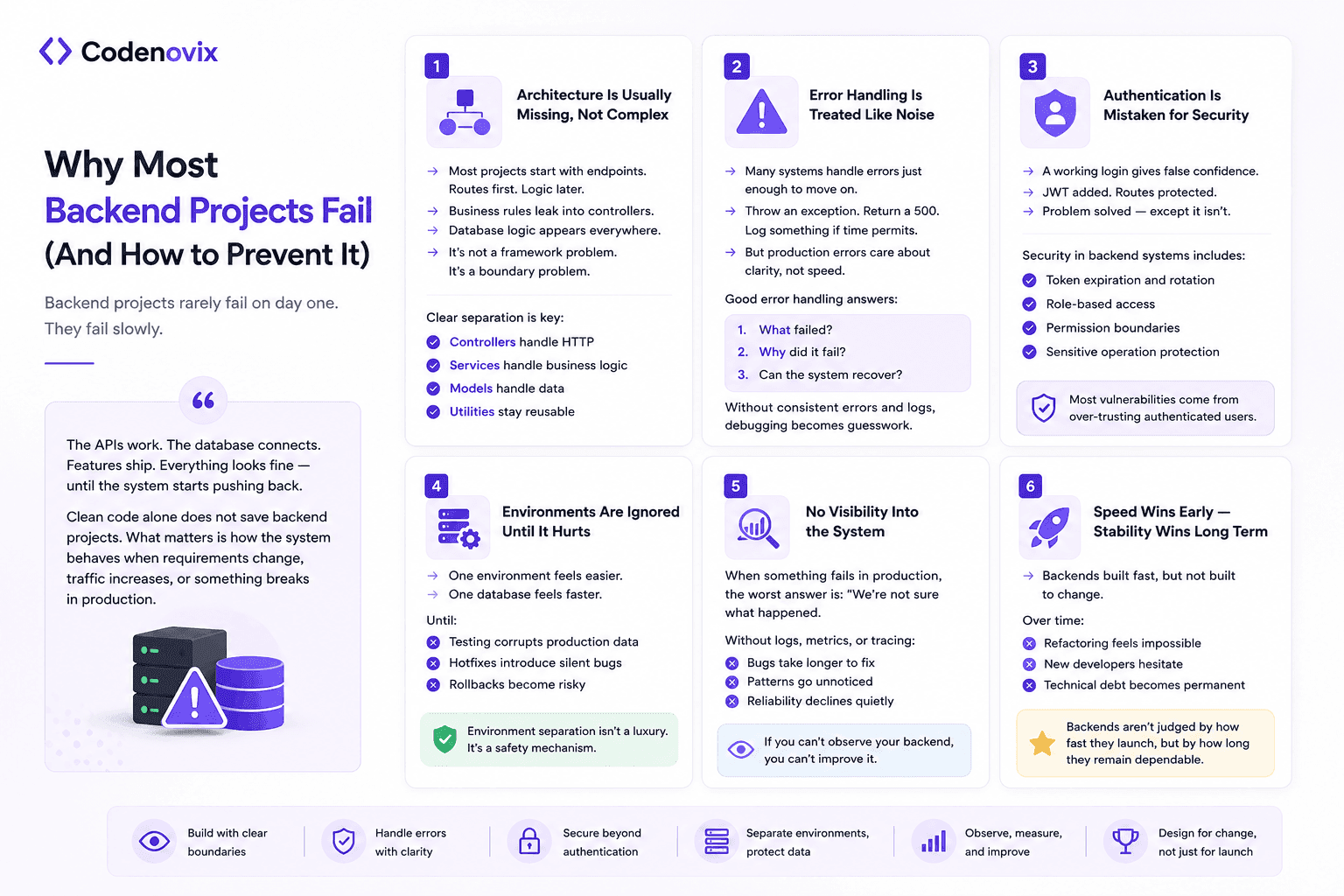
Backend projects rarely fail on day one. They fail slowly.
The APIs work. The database connects. Features ship. Everything looks fine — until the system starts pushing back.
I've learned this the hard way: clean code alone does not save backend projects. What matters is how the system behaves when requirements change, traffic increases, or something breaks in production.
Architecture Is Usually Missing, Not Complex
Most backend projects start by creating endpoints. Routes first. Logic later. Structure eventually — maybe.
At first, this feels productive. Then the codebase grows.
Business rules leak into controllers. Database logic appears in random places. Changing one feature quietly breaks three others.
This isn't a framework problem. It's a boundary problem.
A backend needs clear separation:
- Controllers handle HTTP
- Services handle business logic
- Models handle data
- Utilities stay reusable
Without this, every change feels dangerous.
Error Handling Is Treated Like Noise
Many systems handle errors just enough to move on.
Throw an exception. Return a 500. Log something if time permits.
But production errors don't care about speed. They care about clarity.
Good error handling answers:
- What failed?
- Why did it fail?
- Can the system recover?
Without consistent error responses and meaningful logs, debugging becomes guesswork — and guesswork is expensive.
Authentication Is Mistaken for Security
A working login gives false confidence.
JWT added. Routes protected. Problem solved — except it isn't.
Security in backend systems includes:
- Token expiration and rotation
- Role-based access
- Permission boundaries
- Sensitive operation protection
Most vulnerabilities don't come from missing auth. They come from over-trusting authenticated users.
Environments Are Ignored Until It Hurts
One environment feels easier. One database feels faster.
Until:
- Testing corrupts production data
- Hotfixes introduce silent bugs
- Rollbacks become risky
Environment separation isn't a luxury. It's a safety mechanism.
Development should be free to break things. Production should never be.
No Visibility Into the System
When something fails in production, the worst answer is: "We're not sure what happened."
Without logs, metrics, or request tracing:
- Bugs take longer to fix
- Patterns go unnoticed
- Reliability declines quietly
If you can't observe your backend, you can't improve it.
Speed Wins Early — Stability Wins Long Term
Many backends collapse under their own success.
They were built fast, but not built to change.
Over time:
- Refactoring feels impossible
- New developers hesitate to touch code
- Technical debt becomes permanent
Backend systems aren't judged by how quickly they launch. They're judged by how long they remain dependable.
Found this useful?
Share it with the dev community or cross-post with a canonical link back here.
Cross-posting to dev.to or Hashnode? Use this as your canonical URL: https://www.codenovix.com/blog/why-most-backend-projects-fail
Related articles
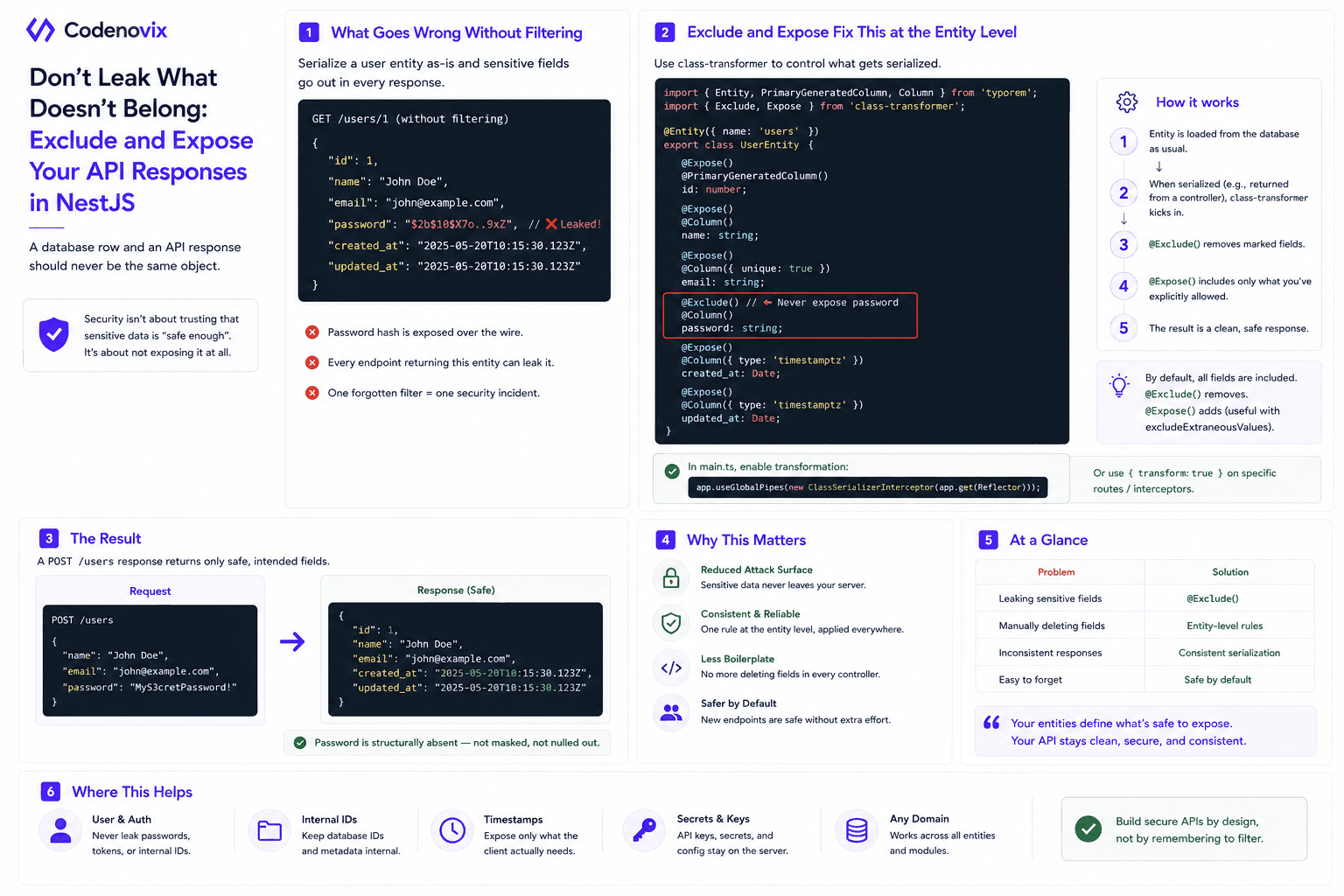
Using Exclude and Expose in NestJS Entities to Control API Responses
A hashed password still shouldn't leave your API. class-transformer's @Exclude and @Expose decorators make an entity define what's safe to serialize, instead of trusting every controller to filter it manually.
 Vanshit Patel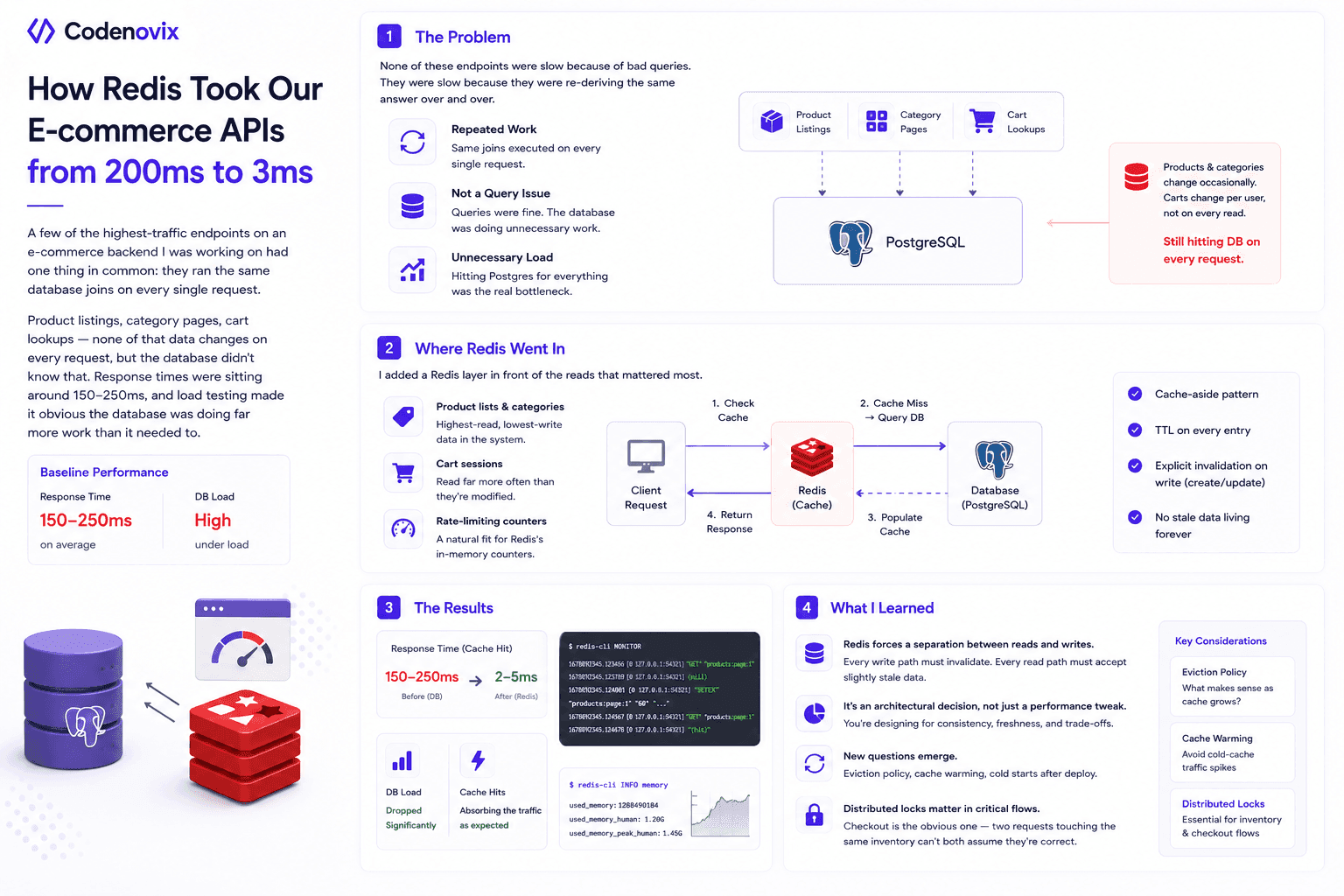
I Added Redis Caching to My E-Commerce Backend, and the Performance Difference Surprised Me
High-read endpoints were re-running the same database joins on every request, pushing response times to 150-250ms. Here's how a cache-aside Redis layer cut that to single-digit milliseconds.
Vanshit PatelHow Designing a Clean Backend Folder Structure Improved Performance and Scalability
A messy backend structure doesn't just look bad — it slows down debugging, onboarding, and scaling. Here's how reorganizing folders into Core, Config, Module, and Shared layers changed both.
Vanshit Patel